
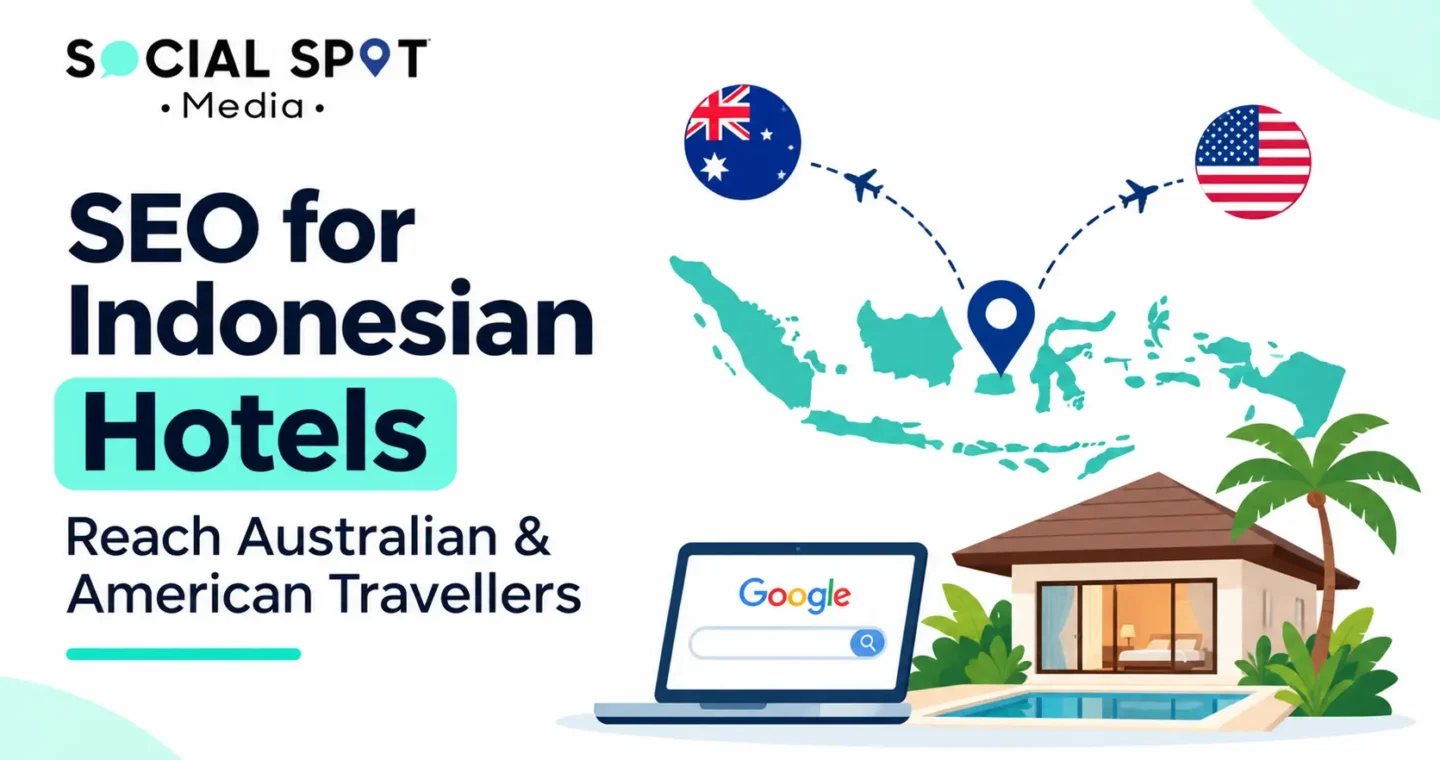
SEO for Indonesian Hotels: How to Get Found by Australian and American Travellers

Many hotels, villas, guesthouses and tour operators in Indonesia still depend on booking platforms to reach guests from Australia and the United States. Yet those travellers also search Google directly for places to stay, things to do and holiday ideas before they decide where to book.
Good SEO for Indonesian hotels helps your business show up in those searches, so more guests find your own website and book with you directly. The key isn’t just translating your site into English. It’s understanding what travellers from each country need to know before they book.
This guide walks through the practical steps: what to show on your website, how Australian and American travellers search differently, how to set up your Google Business Profile, how to earn trusted reviews, which technical basics matter, and how to plan content around peak travel periods.
Why Australians and Americans Search Differently
Both groups search for stays in Bali, Lombok or Yogyakarta, but their planning needs aren’t identical. Understanding the differences helps you write more useful pages.
Australian travellers
Australia is much closer to Indonesia than the United States, and Bali is an established holiday destination with flights from several Australian cities. Perth, for example, is considerably closer than Sydney or Melbourne. Actual journey times depend on the route, airline and connections.
Australian travellers often search for:
- Bali holiday accommodation
- Family resorts in Bali
- Private villas in Ubud
- Lombok holiday packages
- Bali airport transfers
- Things to do in Nusa Penida
They tend to compare location, flight convenience, family facilities, cancellation policies and total holiday cost.
American travellers
For travellers from the United States, Indonesia is generally a longer journey, often with one or more connections. A longer trip usually means more detailed planning, so they compare accommodation, airport transfers, multi-day itineraries, activities and the total cost of the holiday.
Common search themes include:
- Best villas in Bali
- Bali private tours
- Indonesia island hopping tours
- Ubud accommodation
- Bali honeymoon resorts
- Komodo National Park tours
If you want American guests, describe the whole experience, not just the room or activity.
Avoid assuming every visitor from one country behaves the same way. Use your booking records, inquiry data and Google Search Console to see what your own customers actually search for.
A practical comparison
This table is general marketing guidance, not exact travel statistics. Preferences vary by traveller, destination and budget.
| Factor | Australian travellers | American travellers |
|---|---|---|
| Before booking | Flight convenience, location, reviews and total price | Itinerary, accommodation, transfers and experience details |
| Price display | AUD is useful | USD is useful |
| Travel periods | Australian school holidays, Christmas and winter escapes | Summer holidays, Thanksgiving and Christmas breaks |
| Helpful content | Family holidays, beach stays and weekend extensions | Multi-day itineraries, island tours and detailed travel guides |
Don’t treat this as a substitute for your own data. Check which markets actually generate inquiries and bookings before investing in separate campaigns.
Step 1: Show the Right Details on Your Website
Your website should answer the questions a traveller needs settled before booking. A visitor from Sydney or Chicago may not know where you are, how far you are from the airport or whether transfers are available, so make those details easy to find.
Display prices in international currencies
Show your main prices in Indonesian rupiah (IDR) and consider adding indicative AUD and USD amounts. For example:
- Room rate: IDR 1,500,000 per night
- Indicative price: about AUD 145 / USD 95 (illustrative figures at an example exchange rate)
State clearly that converted amounts are estimates, show the currency the guest will actually pay before checkout, and update exchange rates regularly.
Make direct booking easy
Use a visible booking button. Visitors should be able to:
- Select check-in and check-out dates.
- Choose the number of guests.
- See room or villa availability.
- Understand taxes and additional charges, including any tourist levy or government charge that applies. Check the current rules for your destination.
- Complete a booking or send an inquiry.
If you run tours, list the duration, meeting point, inclusions, exclusions and available dates.
Explain airport transfers and travel times
Add a dedicated location section covering the nearest airport, approximate driving time, transfer options, pickup arrangements and extra charges. A villa in Ubud should explain the journey from Ngurah Rai International Airport, not just say it’s “in Bali”.
Include cancellation and entry information
Write your cancellation policy in plain English, covering deposits, refunds, date changes and no-shows. For visa and entry rules, link to the official Indonesian e-Visa website. Requirements depend on nationality and circumstances, so avoid blanket visa promises.
Step 2: Write in Each Market’s English
One English website can serve both Australian and American visitors, as long as the wording feels natural to each.
Australian English commonly uses “holiday”, “colour” and “centre”, along with terms like “accommodation” and “holiday packages”. American English commonly uses “vacation”, “color” and “center”, along with terms like “vacation rentals” and “guided experiences”.
You don’t need two separate websites. Start with a clear international English version and add regional variations where they genuinely improve relevance.
An illustrative before-and-after
This example is fictional and isn’t a real client project.
Before: “Luxury villa in Bali with beautiful rooms and swimming pool. Contact us for booking.”
Australian-focused version: “Enjoy a private Bali holiday in a spacious villa with a swimming pool, daily housekeeping and convenient airport transfers. Check availability for your next island getaway.”
American-focused version: “Plan your Bali vacation in a private villa with a swimming pool, daily housekeeping and convenient airport transportation. Explore availability and arrange your stay.”
The property is the same; only the language changes to match how each audience describes its trip. For businesses targeting both markets, international SEO should focus on useful localization, not swapping a few words across hundreds of pages.
To see how country-specific strategies differ, explore our SEO services for Australian businesses and SEO services for US businesses.
Step 3: Set Up Your Google Business Profile for Overseas Searchers
Your Google Business Profile helps travellers discover your hotel, villa or eligible tour business in search and on Maps. Claim and verify it first, then check the following. For a deeper look at this, see our local SEO service.
Choose the right primary category. A hotel, resort, guesthouse or tour operator should pick the category that accurately describes its main business, and add secondary categories only where they genuinely apply.
Upload photos that help travellers decide. Include:
- Exterior and entrance
- Bedrooms and bathrooms
- Pools and common areas
- Restaurant and breakfast areas
- Tour activities and meeting points
- Airport pickup or transport arrangements
Use recent, genuine photos. Avoid stock images that misrepresent your property.
Add attributes and booking information. For hotels, check amenities such as Wi-Fi, parking, breakfast and airport shuttle, and add your website and a booking link where supported. Google publishes guidance for hotel profiles, so check its current help pages for what’s available in your region.
Keep answers consistent. Travellers constantly ask whether airport pickup is available, whether breakfast is included, whether children are welcome, whether private tours can be booked and which payment methods you accept. Answer these in clear English on your website and in your profile description, and keep them consistent everywhere.
Step 4: Earn Reviews Overseas Travellers Trust
A guest from Australia or the US doesn’t know your business personally. Genuine feedback from past visitors gives them what they need to choose you over another property.
How to ask for reviews
Send a polite follow-up after checkout or after a tour, with a direct review link. For example:
“Thank you for staying with us. We hope you enjoyed your time in Indonesia. If you have a moment, we’d appreciate an honest review of your experience. Your feedback helps future travellers make informed decisions.”
Which platforms matter
Choose platforms based on your business type and where your customers research travel:
- Google Reviews: useful for discovery and local reputation.
- Tripadvisor: relevant to accommodation, attractions and experiences.
- Booking.com and Expedia: important if you take reservations there, though reviews on these usually come from guests who booked through the platform.
- GetYourGuide: relevant to eligible tours and activities.
You don’t need to chase reviews everywhere. Focus on the platforms your guests actually use.
Respond in English
Thank guests for positive feedback. If someone reports a problem, acknowledge it and explain how you’ll address it. Never buy reviews or ask staff to write fake guest experiences. A few genuine, detailed reviews are worth more than a misleading pile of ratings.
Step 5: Fix the Technical Basics
A site that looks great on your laptop can perform badly for someone browsing on a mobile connection overseas. Test yours with PageSpeed Insights on both mobile and desktop, and prioritize the following. Our technical SEO team handles these regularly.
Mobile speed. Compress large photos, use modern formats such as WebP, remove unnecessary scripts and avoid oversized video backgrounds.
Hosting and CDN. Choose hosting that’s reliable for your target markets. A Content Delivery Network can serve images and other static files from locations closer to visitors, but test real performance rather than assuming it fixes every speed problem.
Structured data. Use Schema.org markup that describes your actual business. A hotel can use Hotel or LodgingBusiness markup, and tour pages can use suitable service and business markup. For vacation rentals, Google documents a specific VacationRental structured-data feature, but it has eligibility requirements and Hotel Center access. Markup alone doesn’t guarantee a special listing.
International versions and hreflang. If you publish separate Australian and American versions of a page, hreflang tags (en-AU and en-US) help Google understand which is meant for whom. Each version should reference itself and its alternates, with matching return annotations. If one international English page works for both markets, you don’t need separate pages or hreflang. Google explains the requirements in its localized versions documentation.
Step 6: Plan Content Around Peak Travel Periods
Plan tourism content before travellers start researching.
Australian travel periods include school holidays in April, June and July, September and October, and the December to January summer break. Dates vary between states and territories, so check each state’s official school term calendar before planning campaigns.
American travel periods include summer holidays, Thanksgiving, Christmas and New Year, and Spring Break, depending on school and university calendars. The US federal holiday calendar helps with public holiday dates, though private schools and universities may differ.
Here are some content ideas:
| Travel period | Suggested content |
|---|---|
| Australian winter | Bali winter escape and family villa stays |
| Australian summer | Bali Christmas and New Year accommodation |
| US summer | Indonesia island-hopping itineraries |
| Thanksgiving | Indonesia holiday planning guide |
| Christmas and New Year | Private villa and group holiday experiences |
| Spring Break | Bali adventure tours and group activities |
Publish important pages before the relevant booking period, and track impressions and inquiries to see which topics attract visitors from each country.
Common Mistakes Indonesian Tourism Websites Make
- One generic page for every country. A single page may not answer the specific questions of Australian and American visitors. Tailor the content where needs genuinely differ.
- No prices displayed. Travellers can’t compare options when every page says “contact us for prices”. Show starting prices or a clear quotation process.
- Slow mobile pages. Large villa photos and videos can make a site hard to use on mobile connections.
- Unanswered inquiries. An international visitor may message several properties. A slow reply can cost you the booking.
- Ignoring reviews. Unanswered negative feedback leaves travellers unsure how you handle problems.
When SEO Will Take Longer
SEO doesn’t produce instant bookings. A new hotel website with few reviews, limited content and little search visibility may need several months of consistent work before results become noticeable.
Competition also varies. A private villa in a crowded Bali market faces different challenges from a specialist tour operator in a less competitive destination. And direct bookings depend on availability, pricing, payment options, customer service and the quality of the experience itself. SEO can bring qualified visitors, but it can’t guarantee they’ll complete a reservation.
How Social Spot Media Helps Indonesian Tourism Businesses
Social Spot Media works remotely with hotels, villas, guesthouses and tour operators in Indonesia. Our team is based in Noida, India, and we don’t have offices in Indonesia, Australia or the USA. Western Indonesia Time (WIB) is only about 1.5 hours ahead of India, so scheduling calls during your working day is straightforward.
Our work can include:
- Technical SEO and website optimization
- International keyword research
- Local SEO and Google Business Profile support
- English content strategy and Bahasa Indonesia content written by native writers
- On-page and off-page SEO
- AI search optimization
- Monthly reporting on website performance and inquiries by country, where tracking data is available
SEO packages start at USD 499 per month, and the scope depends on your website, target markets and goals. Learn more about our digital marketing services for Indonesian businesses and our work in hospitality marketing.
Frequently Asked Questions
Can a Bali villa rank on Google in Australia?
Yes. A Bali villa can attract Australian search traffic through relevant accommodation pages, useful information, genuine reviews and an accessible booking process. Rankings depend on competition, website quality and search relevance.
Should Indonesian hotels display prices in AUD and USD?
Displaying indicative AUD and USD prices can help Australian and American visitors compare costs. Keep IDR as the reference currency and clearly explain that converted amounts may change with exchange rates.
Do hotels need separate websites for Australian and American travellers?
No. One well-organized English website can serve both markets. Separate regional pages are useful only when they contain meaningful differences in language, pricing, offers or customer information.
How can Indonesian tour operators get direct bookings from overseas travellers?
Create detailed tour pages with itineraries, inclusions, prices, meeting points, cancellation terms and a simple booking process. Support them with useful search content, genuine reviews and clear inquiry options.
How long does SEO take for an Indonesian hotel?
It depends on the website’s current condition, competition and existing online reputation. Expect ongoing work over several months rather than immediate booking growth, and measure progress through inquiries and direct reservations as well as search visibility.
Your Next Steps
To win more direct bookings from Australian and American travellers:
- Fix your website: show prices in IDR, AUD and USD, clear location details, amenities and direct booking options.
- Understand your travellers: write content that matches what Australian and American visitors actually need.
- Optimize your Google Business Profile: complete your details, photos, amenities, booking link and genuine reviews.
- Build trust: ask guests for honest reviews after their stay or tour.
- Fix the technical basics: make sure your site is fast, mobile-friendly and clear.
- Track results monthly: review traffic, visitor countries, inquiries and direct bookings.
Want to know where your tourism website stands today? Request a free website SEO audit or contact Social Spot Media.